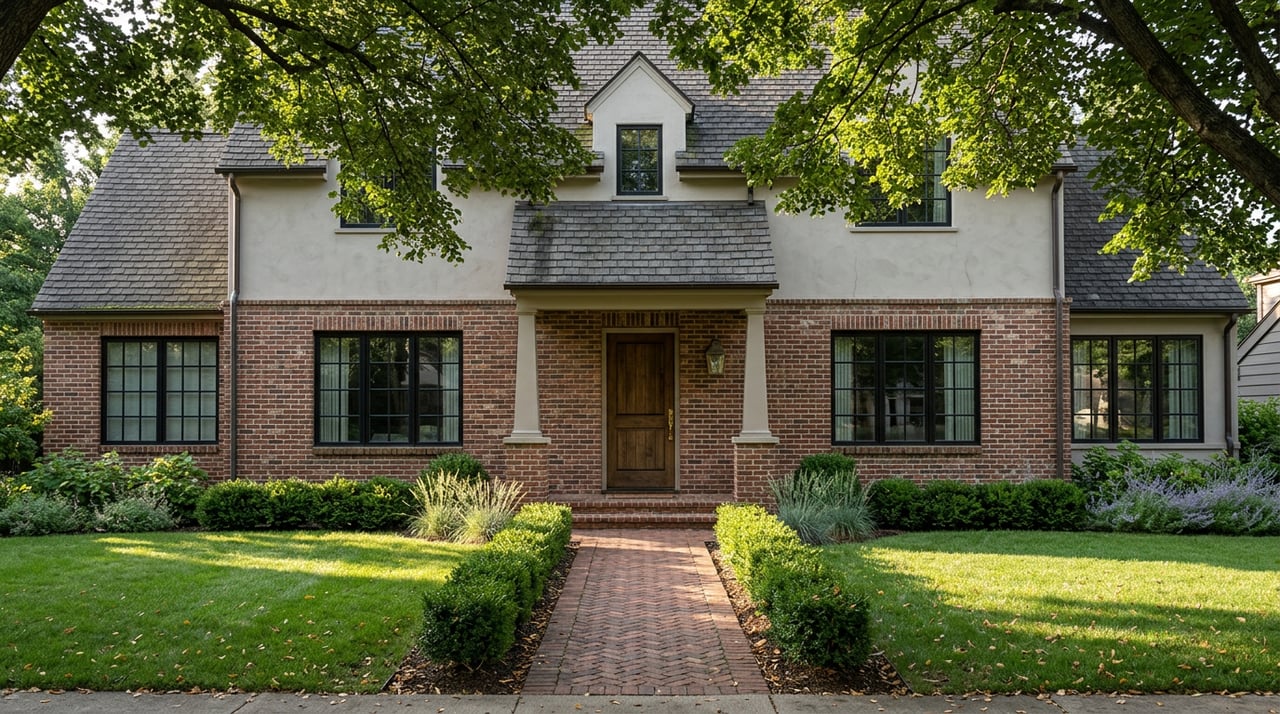
Walk the 7th Avenue Parkway on an August evening and the canopy does something most people who live under it have never quite named. Somewhere around Milwaukee Street, the mood changes. West of there, the median reads formal: symmetrical rows, clipped beds, a sense that someone drew this on graph paper. East of Milwaukee, it loosens into something closer to a small forest, evergreens of every size and shape crowding the grass strip with no obvious pattern at all.
That's not your imagination, and it's not decay or neglect creeping in from one direction. It's two separate planting jobs, done by two different designers, more than a decade apart, stitched together at a single cross street. Almost nothing written about this district mentions the seam. It's worth knowing, especially this year, because the story of what's happening to the trees overhead runs right through it.
Two Designers, One Boulevard
The city bought the land for the parkway in 1912 and brought in the Frederick Law Olmsted firm, the same firm behind New York's Central Park, to consult on the western stretch. From Williams Street to Milwaukee Street, History Colorado's landmark record describes the result as formal, with symmetrical plantings of specimen trees and garden beds set into the median's sun-facing gaps.
Construction on the rest of the parkway didn't happen for another two years, and it wasn't finished until 1927. That later stretch, from Milwaukee Street out to Colorado Boulevard, was handed to city landscaper Saco DeBoer, and he took the opposite approach: an informal planting of evergreens, deliberately varied in color, shape, size, and texture, built to feel less like a garden and more like a wood. The Denver Public Library's history of the district notes the 1912 planting ran Williams to Milwaukee, and the second phase in 1927 finally closed the gap to Colorado Boulevard.
Here's the comparison, stripped down to what actually changes underfoot:
| Stretch | Streets | Built | Design approach | What you'll notice |
|---|---|---|---|---|
| West half | Williams St to Milwaukee St | 1912 | Formal, Olmsted-influenced | Symmetrical specimen trees, garden beds set into the median |
| East half | Milwaukee St to Colorado Blvd | 1914 to 1927 | Informal, DeBoer | Evergreen forest planting, mixed shapes and textures, no clear pattern |
City crews still plant the median's sun-facing garden beds every year, the same ones locals and the historical record both call "sun spots." So the seasonal color you notice each spring isn't leftover from a century ago. Someone plants it fresh, on both halves of the boulevard, every year.
What's Actually Holding Up the Canopy
The tall trees lining both curbs, the ones that make the whole 1.4-mile stretch read as one continuous tunnel of shade even though the median underneath them is doing two different things, are Olmsted's contribution too: a double row of elms running the length of the parkway. A lot of those original trees are still standing more than a century later.
That's the detail that matters most right now, because Denver's elms have had a rough few years. In 2023, Dutch elm disease turned up again on the city's historic parkways, specifically on the 17th Avenue Parkway in South Park Hill, after a twelve-year absence. Denver Westword reported that seven of the city's oldest elms, some pushing 120 years, were lost before crews could contain the outbreak.
"It might be because of the moisture we've gotten," Denver's city forester said of the disease's sudden reappearance.
Then in 2025, the emerald ash borer arrived. Denverite confirmed that the beetle, which had already been spreading through Boulder and Longmont for years, had officially reached Denver and started threatening the city's ash population. Between the two pests, Denver's oldest street trees are facing pressure from both directions at once, on the exact kind of century-old parkway plantings that make up the 7th Avenue canopy.
What to Actually Watch For
None of this means panic. It means knowing what a sick tree looks like before it's too late to do anything about it. Denver's forestry program breaks the warning signs down clearly:
- Leaves in the crown yellowing and wilting quickly, then turning brown and curling, a signature pattern of Dutch elm disease
- D-shaped exit holes in the bark, peeling or flaking bark, or unusually heavy woodpecker activity, which often points to emerald ash borer
- Any of the above on a tree in the public right of way, which is the city's responsibility, not a resident's to prune or remove
If you spot something on the parkway or on your own block, Denver's Office of the City Forester takes reports at 720-913-0651 or [email protected]. The city's Be a Smart Ash program has already treated roughly 6,000 ash trees in parks and parkways and removed more than 1,000 that were too far gone, with about 1,500 new trees going in every year to keep any one species from dominating the canopy again.
Who's Actually Watching the Trees
The people paying closest attention aren't city staff, they're the neighbors. The Seventh Avenue Neighborhood Association, known locally as SANA, holds its general meetings at Good Shepherd Church, right on 7th Avenue at Elizabeth Street. On its own site, SANA describes a scene most people who live here would recognize without needing it explained: runners and walkers on their daily route, cyclists commuting to work, parents pushing strollers, dog owners out with their dogs, all sharing the same canopy the association calls "Denver's most beautiful neighborhood."
That canopy also does more than shade one street. The parkway is one of three park system pieces inside the district, alongside the Cheesman Esplanade and the Williams Street Parkway, and together they form a green connector linking Cheesman Park, City Park, and Washington Park. Walk far enough in either direction and you're not just on 7th Avenue anymore, you're on a thread that ties three of Denver's major parks together, a design choice baked in from the start rather than something that happened by accident.
Why the Seam Matters More Than the Postcard
Every description of this district reaches for the same handful of words: historic, tree-lined, elegant. All true, none of it useful to someone who already walks this route twice a day. What's actually useful is knowing that the calm, symmetrical stretch near Williams Street and the loose, evergreen stretch out toward Colorado Boulevard were never meant to feel the same, that the boundary between them sits at Milwaukee Street, and that the elms holding up the whole canopy are living through the most serious disease pressure Denver's parkways have faced in over a decade.
Next time you're out for an evening walk and the light changes character somewhere past Milwaukee, that's not the golden hour playing tricks. That's more than a hundred years of two very different garden plans, still doing exactly what they were designed to do.
Whether you've watched this canopy from the same porch for twenty years or just started noticing where the formal half gives way to the wild one, Linkow Baltimore Team knows this stretch of Denver block by block. If you're ever curious what a home on either side of Milwaukee Street is actually worth today, start with a free home valuation.